
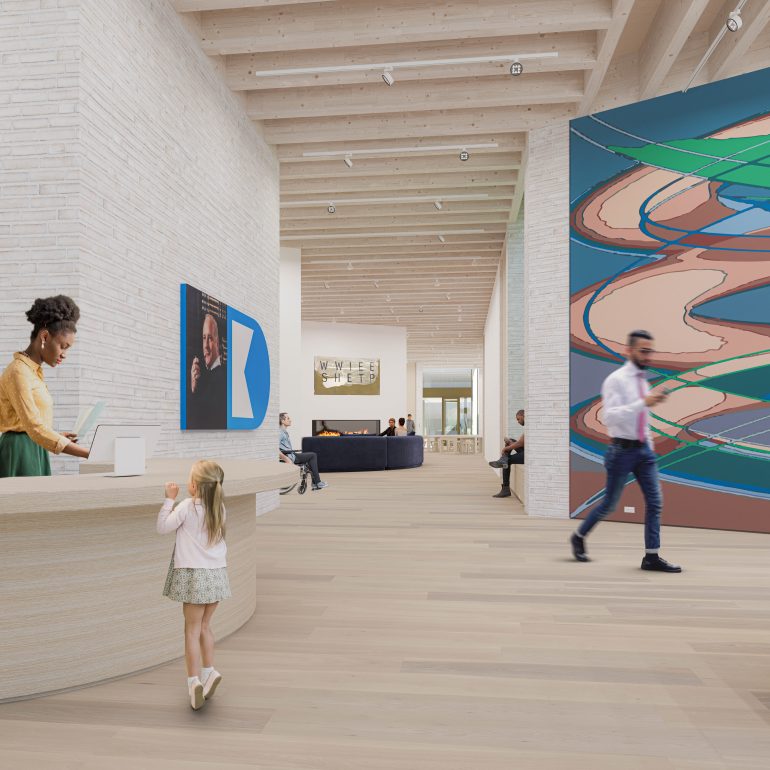
AUG. 7, 2025 (VANCOUVER, CANADA) — Simon Fraser University will open the landmark Marianne and Edward Gibson Art Museum (the Gibson) on Sept. 20, 2025, with the inaugural group exhibition Edge Effects. The institution marks the beginning of a new cultural legacy for the university, as its first purpose-built art museum that consolidates what was previously known as SFU Galleries. Featuring an award-winning design by Siamak Hariri, founding partner of Toronto-based Hariri Pontarini Architects, in partnership with Vancouver-based Iredale Architecture, the 12,100-square-foot museum is defined by its unique polygonal form and expansive windows that draw in the natural landscape and foster a sense of openness.
“In part inspired by the intelligence of trees and their underground networks of communication and support, the Gibson is a space where art and learning come together to create a vibrant canopy of activity supported by deep connections,” says Kimberly Phillips, director of the Gibson. “My desire for natural light and porosity, for bringing the outside in, stems in part from Dr. Edward Gibson’s own belief, as an urban geographer, in art’s connection to its surroundings and the unique experience of Arthur Erickson’s architecture on the Burnaby campus. Many works in the SFU Art Collection are deeply rooted in this place, reflecting its history and territories. As the new home for this collection, the Gibson deserves to be a space open to the world, allowing the art to engage with the very environment from which it emerged.”
The Gibson’s architectural and design details all highlight this sense of flow and warmth, including the craftsmanship of its intricate brick work and the decision to have two entrances into the building: one facing the SFU Transit Exchange (main bus loop) and the other toward the campus that allow visitors to explore seamlessly. The structure is made from BC-sourced mass timber beams that distinguish the 15-foot-high ceilings. The building is fully electric and LEED Gold certified. Flexible programming spaces feature areas with long tables for farmhouse style seating and a central hearth that will serve as the home of a new site-specific, semi-permanent installation by Cindy Mochizuki. In addition to the furniture designed locally by Lock & Mortice, there are pieces brought in from international companies, such as fully compostable upholstered lounges from Milan-based Studio Urquiola and the Danish-made bricks that reference Erickson’s favoured concrete but are characterized by a warmer colour.
The inaugural exhibition is titled Edge Effects, a reference to the ecological term “edge effect,” which describes the conditions created where two adjacent ecological communities meet, such as an estuary between a river and the ocean. This results in a rich and complex co-existence between species that would otherwise never have the chance to interact. In this vein, the museum explores its position at the boundary of academia and the public, and the participating artists of the inaugural exhibition consider edges in their practices that challenge disciplinary, material, and historical boundaries.
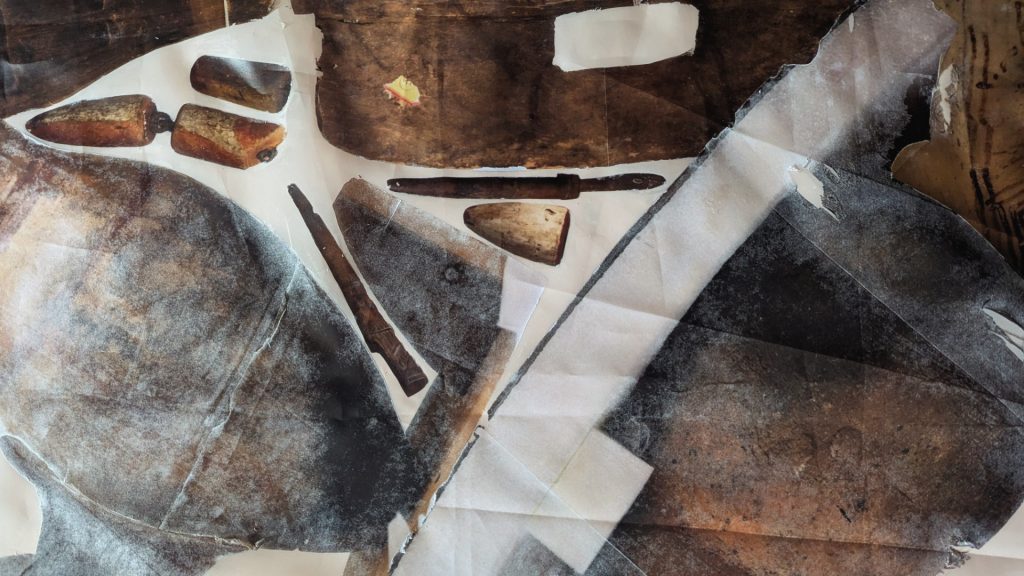
Edge Effects features a combination of new commissioned works and projects never before seen by audiences in Canada, such as Liz Magor’s still poignant Blue Students/Alumnos en azul (1997). Originally commissioned by INSITE97, the public project centred on photographic portraits of students from the School of Creative and Performing Arts in San Diego, California, and the Preparatoria Federal Lázaro Cárdenas in Tijuana, Mexico, that were placed throughout both cities. The film negatives were pressed with paper covered in iron salts, which converted into positive blue images as they were exposed to sunlight. By the end of the installation period, only a few portraits had not been completely obscured, with the artist stating that the legibility of the images represented the power of circumstance and chance that governs people’s lives.
Cindy Mochizuki’s Arboreal Time is a constellation of more than 40 miniature and medium-sized hand-built porcelain sculptures and yakisugi (preserved charred wood) pine elements that chart a forest of kodama, or tree spirits, mounted above the central hearth and fireplace wall at the Gibson. The work reflects the ways in which trees experience the passage of time in a cyclical, non-linear way, and invites visitors to linger in the space while co-existing with these strange creatures.

Lorna Brown will present a major project about easements in Vancouver that has been over a decade in the making, featuring a large-scale wall drawing, soft sculptures, and sound work. Elisa Ferrari is working with SFU’s archive, creating sonic collages that query mythologies about the university’s early turbulent days using voice recordings of past administrators, faculty, and students. Sameer Farooq and poet Jared Stanley reconsider the storage spaces of SFU’s Archaeology and Ethnology Museum as a “loom” that catches and holds objects and belongings from vastly different times and places. And Pietro Sammarco, with Liz Toohey-Wiese and Helena Krobath, worked with University Highlands Elementary students over eight weeks to create sound compositions and paintings that explored the path of rainwater down Burnaby Mountain.
Additional artists in Edge Effects are: Justine A. Chambers, Patrick Cruz, Lucien Durey, Germaine Koh, Debra Sparrow, and Jin-me Yoon, as well as several works from the SFU Art Collection. Many of the featured artists have close ties with SFU, as alumni, current students, faculty, and visiting fellows.
The Gibson will open to the public with a family-friendly program on Saturday, Sept. 20 from 2–5pm. Following welcoming remarks, there will be a performance by Lucien Durey, an art studio with kids’ activities, light snacks and refreshments. On Sunday, Sept. 21, the museum will host an artist talk with Patrick Cruz, Sameer Farooq and Jared Stanley at 2pm. Additional programs will be announced closer to the fall, including a clay kodama-making workshop with Cindy Mochizuki, a newly commissioned dance performance by Justine A. Chambers, a Coast Salish weaving workshop, a sound performance with Elisa Ferrari, and the launch of the inaugural exhibition’s publication Holdfast: On Creating the Marianne and Edward Gibson Art Museum this winter.
For more information about the museum, visit gibson.sfu.ca. Details about the exhibition will be published online closer to the opening.
Acknowledgements
The Marianne and Edward Gibson Art Museum is generously supported by Simon Fraser University, the Canada Council for the Arts, and the British Columbia Arts Council, along with numerous Friends of the Gibson, foundations, community partners, and volunteers. We are especially grateful for the visionary support of the Marianne and Edward Gibson Trust.
Edge Effects is generously supported by: Coleen and Howard Nemtin Bruce Munro Wright
Exhibition sponsor: Scott Construction Group
Community partners: Arterra Wines, Parallel 49 Brewing Company
About the Marianne and Edward Gibson Art Museum
The Marianne and Edward Gibson Art Museum’s mission is to encourage open and inclusive learning about our past, current, and future worlds—including crucial considerations of the west coast region—by supporting the work of critically engaged and research-driven visual artists. Echoing the building’s open and informal design that strives to put accessibility first, the Gibson’s staff team is committed to creating a space where complex and challenging ideas can be encountered inclusively.
We welcome diverse audience communities with multi-generational, year-round programming, activating artists’ work through the creation of research opportunities, exhibitions, commissions, publications, residencies, and a diverse array of public events. We carry out our work in the context of Simon Fraser University—a public research university known for its radical beginnings and commitment to community engagement and interdisciplinary research. We also care for, grow, and activate the SFU Art Collection, with current holdings of over 5,900 works by provincially and nationally recognized artists dating from the last and current centuries. The Gibson Art Museum is located on the unceded territories of xwməθkwəy̓ əm, Skwxwú7mesh, Səl̓ílwətaɬ, and kwikwəƛ̓ əm Nations. Acknowledging that our work takes place on colonized Indigenous territories is both a recognition that settler colonialism is an ongoing structure and a commitment to support the capacity of art to unsettle these conditions. Our programs are always free of charge and open to all.
Museum hours
Wednesday to Sunday, 11am–5pm Group exhibition tours and class visits are welcomed by appointment
Address
SFU Burnaby Campus 8888 University Drive Burnaby, British Columbia V5A 1S6