

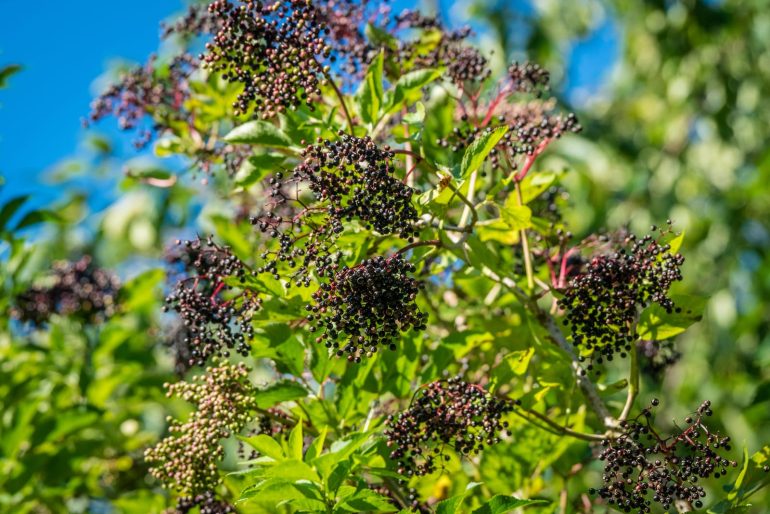
By Klaus Ferlow, HMH, HA
My own personal experience with the Elderberry Plant has been nothing short of a miracle.
As a child, I grew up in a small farm village with a population of 3600, located in Northern Germany between Hamburg and the Danish border. Between 1945 -1955 I was an outdoor person year-round and developed a special feeling and love for Mother Earth and what nature had to offer. My favorite color was green. My mother could not keep me inside the house and I was very active in sports, soccer, handball, volleyball, baseball, ice hockey and gymnastics.
In those childhood years, I stayed at my grandmother’s farm in East Prussia, Germany all summer. There I explored the trees, vegetables, and herbal plants. It was during this time that my mother and grandmother taught me about the benefits and healing power of herbs, which ultimately led me to be become the fourth generation herbalist in our family.
From the Dominion Herbal College, the oldest North American School of Herbal Medicine (100th anniversary in 2026), I received a Master Herbalist Diploma. And from the Canadian Council of Herbalist’s Associations I received a Certificate as “Herbal Elder of Canada” in recognition of my role as notable contributor in the field of herbal medicine for at least 25 years!
My Personal Experience with Elderberry
During my childhood I sometimes developed a fever, so my mother would put me to bed to rest and recuperate. The herbal medicine administered was a large cup of pure elderberry juice with lemon juice and honey. I also received an elderberry poultice on my chest, sometimes even on my legs. The juice enhanced my immune system to the point that my pyjama were soaked in the morning from sweating all night, but the fever was gone, and I never missed a day in school!
I complained to my mother that I preferred to stay home during times of sickness (like other kids) but her answer was: “You have to go to school and learn!”
We had a local elderly medical doctor who did house calls from time to time, but he never prescribed medication. Instead, he told my mother that I needed to go to bed during sickness in the village he had a nickname “Hans-go-to-bed!”
Lots of elderberry plants were growing wild in the fields in our area and my mother also made elderberry soup with dumplings that we all liked, especially in the fall and winter.
History of the Elderberry
The Sambucus nigra plant is found across North America, Europe, North Africa and parts of Asia. The small dark berries from the Sambucus tree have been revered by Indigenous people of North America for centuries. Rich in nutrients and medicinal properties, elderberries have played a significant role in the health, culture, and traditions of many Native American tribes and are considered sacred in Indigenous cultures.
The plant is often refereed to as the “tree of music” because its hollow stems can be used to make flutes and whistles. Important in many ceremonial practices. The elder tree was seen as symbol of protection and healing.
Medical and Therapeutic Uses of Elderberry
The elderberry has been used in folk medicine for relief from:
- Cold and Influenza
- Sinusitis, sore throat, fever, laryngitis
- Bronchitis, coughing, breathing problems
- Herpes, mucous membrane inflammation, sores
- Bruises, headache, pain, swelling, to repel insects, burns, toothache, cancer
- Gout, liver disease
- Constipation, eczema, obesity
Elderberry also works therapeutically:
- Shortens influenza, reduces fever
- Strengthens the cardiovascular system
- Stops gum inflammation, diarrhea
- Alleviates allergies
- Antibacterial and antitussive
- Boosts the overall respiratory system
- Antiviral, emetic, astringent, has a high content of nutrients inclusive vitamins, antioxidants and fiber
- Anti-inflammatory and provides immune system support
The plant is complex, containing bioactive proteins such as lectins, flavonoids, alkaloids, sterols, fatty acids, tannins, and cynagenic glycosides in varies degrees, variety, and plant part. Proven biological effects include antifungal, antibacterial, antiviral, diuretic, hypotensive, anti-inflammatory, and liver protection properties.
Russian Experience
The decorative and medicinal yellow, red, and black Elderberry (European elder of Sambucus nigra) grows in many parts of Russia and has been used as home medicine from the time of their early history. Also worthy to note is the North American white Elder (Sambucus canadensis).
In the Middle Ages, the elder plant was considered a “Holy Tree” capable of restoring and preserving human health, and as an aid of longevity.
To Prepare Elderberry as Food or Medicine
Elderberry can be used as a homeopathic tincture or extract, as powder, making wine, champagne, is user friendly in jam, jelly, syrup, pies, schnapps, brandy, and is also used in pancakes, muffins or dipped in batter and fried. The berries can even be used in frozen yoghurt, fritters, and for dyeing on fabrics. A recipe for elder syrup can be found in the article by Carol Little, RH, entitleded Elder: A Valuable Flu-Fighting Ally for your Fall and Winter Medicine Chest.
As well, a recipe for Elder Flower Tincture can be found in herbalist Michael Vertollie’s article entitled: “Suffering from Summer Allergies? Elder Flower to the Rescue.” https://vitalitymagazine.com/article/suffering-from-summer-allergies-elder-flower-to-the-rescue
And there is an excellent video by clinical Herbalist Yarrow Willard which is explains the many benefits of elderberry medicine (Sambucus negris) and how to prepare elderberry syrup.
Warning:
Some parts of the plant are mildly to moderately toxic, especially the inner bark and root. Only the cooked berries and heated flowers are considered safe for moderate use. The bark, root, leaves and unripe berries are toxic and cause cyanide poising. Children are especially sensitive, even to slight unripe berries.
Modern Uses and Revival
Today, the traditional knowledge of elderberries is being revived and integrated into modern wellness practices. Many people continue to use elderberries for their health benefits, inspired by the wisdom of Indigenous peoples.
As we incorporate elderberries into our modern lives, it is essential to honor and acknowledge the Indigenous knowledge that has preserved the use of this remarkable healing plant for centuries. By respecting and learning from these traditions, we can deepen our appreciation for the natural world and the cultural heritage of Native North America tribes
We have four elderberry plants on our 10 acre property on Roberts Creek on the sunshine coast of British Columbia and will try for the first time to make am elderberry wine.
There are no other plans on Earth that offers medicinal versatility, benefits and the healing power like the elderberry plant (besides the miraculous Neem tree from India).
Words of Wisdom
If you happen to get sick, herbs can provide profound relief. If you invite an elderberry tree in the yard you will invite elves, the nature spirit, and the faeries into your life. – Ellen Ducan
References:
Alma R. Hutchins, Indian Herbology of North America
Steven Foster and Christopher Hobbs, Western Medicinal Plants and Herbs
James A. Duke, The Green Pharmacy Herbal Handbook
Charles W. Fetrow, Juan R. Avila, The Complete Guide to Herbal Medicines
International Herb Association, Elder (Sambucus spp)
Klaus Ferlow is a Master Herbalist (HMH), Herbal Advocate (HA) fourth generation herbalist in the family, educator, formulator, lecturer, researcher, writer, founder of Ferlow Botanicals (1993) and Neem Research (2013), member of the International Herb Association, United Plant Savers, National Health Federation, co-author of the book “7stepsto-dental-health, author of the book “Neem: Nature’s Healing Gift to Humanity”, “Neem: The Tree that heals Nations”., Neem: Your Guide to Natural Health and Beauty” and “Neem: Your Guide to a Bug-Free Home.” The books will be soon available on amazon.
http://neemresearch.ca, https://www.ferlowbotanicals.com, www.worldneemorganisation.org
Disclaimer: Content of this article is for educational purpose only and should not be used for diagnose or treatment of disease. Please contact your health care provider.
Copyright @02/2026