

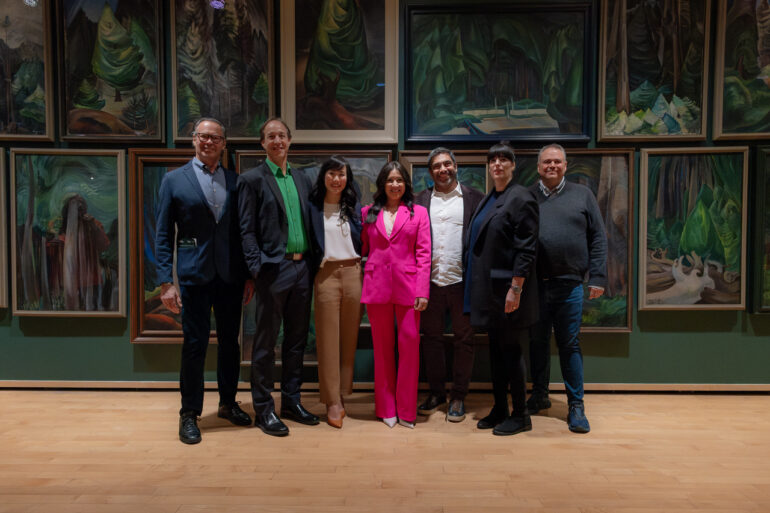
On October 8, the Vancouver Art Gallery announced a landmark $2 million commitment from the Richardson Family that will anchor the future of its Art of Wellbeing program for the next five years. What began as a pilot has demonstrated the profound role art can play in supporting health, connection and wellbeing across communities. This transformational investment establishes Art of Wellbeing as a long-term strategic priority for the Gallery, providing the stability and resources needed to deepen its impact and reach in the years ahead. In recognition of this foundational support, the program will now be known as the Richardson Family Art of Wellbeing Lab.
Since the pilot launched in April 2025, more than 2,280 visitors have accessed the Gallery free of cost through Art of Wellbeing initiatives designed to foster social connection, build resilience and support mental wellbeing. These have included dedicated programs for seniors and youth, expressive art initiatives, accessible visits for community groups, public debates, round tables with healthcare professionals, and social prescribing initiatives.
A significant cornerstone of the Art of Wellbeing Lab is the Gallery’s partnership with BC Parks Foundation’s PaRx initiative, Canada’s national nature prescription program, which enables healthcare practitioners across British Columbia to prescribe nature visits to patients in support of their physical and mental health. The Gallery is now part of this program, offering distinctive art-based nature experiences within its exhibitions, including That Green Ideal: Emily Carr and the Idea of Nature and, moving forward, the British Columbia landscapes presented in Highlights from the Collection. The Gallery’s partnership with PaRx received a 2025 Social Prescribing Changemaker Award from the Canadian Institute for Social Prescribing, recognizing its interdisciplinary approach to advancing social prescribing. The Vancouver Art Gallery and BC Parks Foundation have extended their partnership for a further three years, continuing to explore how museums can provide opportunities for reflection and connection with nature for people who may face barriers to accessing parks and green spaces.
“This work is vital because it responds to the needs of our communities,” says Sirish Rao, Co-CEO & Executive Director at the Vancouver Art Gallery. “We are thrilled for this transformation into the Richardson Family Art of Wellbeing Lab in recognition of Dave Richardson’s generous support and his longstanding commitment to championing the powerful role that art and nature can play in supporting wellbeing. His vision and leadership have been instrumental in seeding this work, helping us to build on what we have learned through the pilot and imagine what is possible in the future.”
The Richardson Family’s $2 million investment will support the next phase of the Lab, expanding opportunities for people to experience the benefits of art and creating greater access for those who may face barriers to cultural experiences.
“Art and nature have the power to nourish the mind, body and spirit. They are a form of medicine, helping to lift our spirits, bring perspective and see the world more positively when life feels overwhelming. Both art and nature have a unique ability to connect people, inspire hope, encourage healing and create a sense of wellbeing,” says Dave Richardson, Presenting Partner of the Richardson Family Art of Wellbeing Lab at the Vancouver Art Gallery. “I am proud to support the Gallery in developing a transformative initiative that brings art, nature and community together. My family and I are delighted to help expand the program’s reach, creating more opportunities for people of all ages to experience joy and connection through meaningful engagement with art and nature.”
For Dr. Carla Fry, PsyD, Director of the Vancouver Psychology Centre, who has been prescribing nature to patients since April 2025, the value of the program lies in creating a space where people can step outside the demands of everyday life.
“Nature and art share a doorway, and that doorway is awe. In front of a painting of a forest or a coastline, people are pulled into something larger than themselves, and the self-monitoring so many of us live with goes quiet”, says Dr. Fry. “Loneliness is a serious public health problem, and slowing down beside someone in front of a painting is a practical response to it. Several patients have shared how the Gallery gave them a sense of calm they hadn’t felt in weeks.”
The Lab’s pilot has demonstrated the potential for museums to contribute to wellbeing in practical and meaningful ways. Its next phase will deepen evaluation and research partnerships, develop new programs in response to community needs and strengthen relationships across the arts, healthcare, nature and community sectors.
The ambition is to develop an evidence-based, community-led framework that can be shared with organizations across Canada and internationally, contributing to a growing understanding of how cultural experiences can support health, wellbeing and social connection.
For more information, or to donate to the future of the program, please visit: vanartgallery.bc.ca/art-of-wellbeing.