

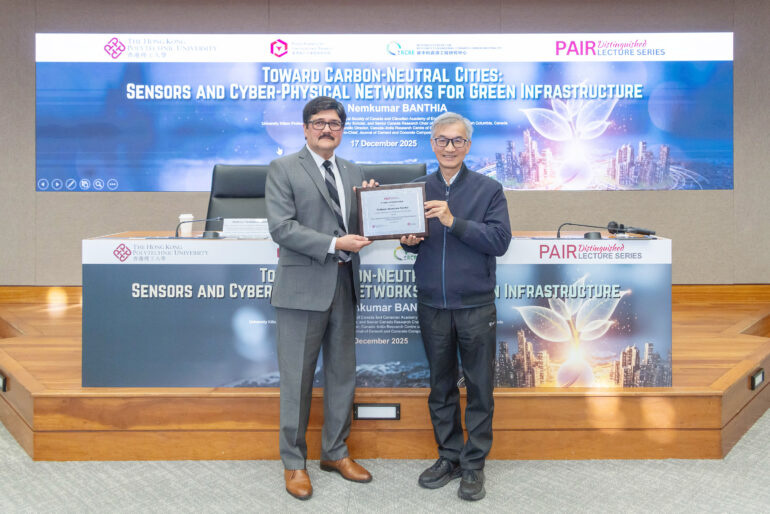
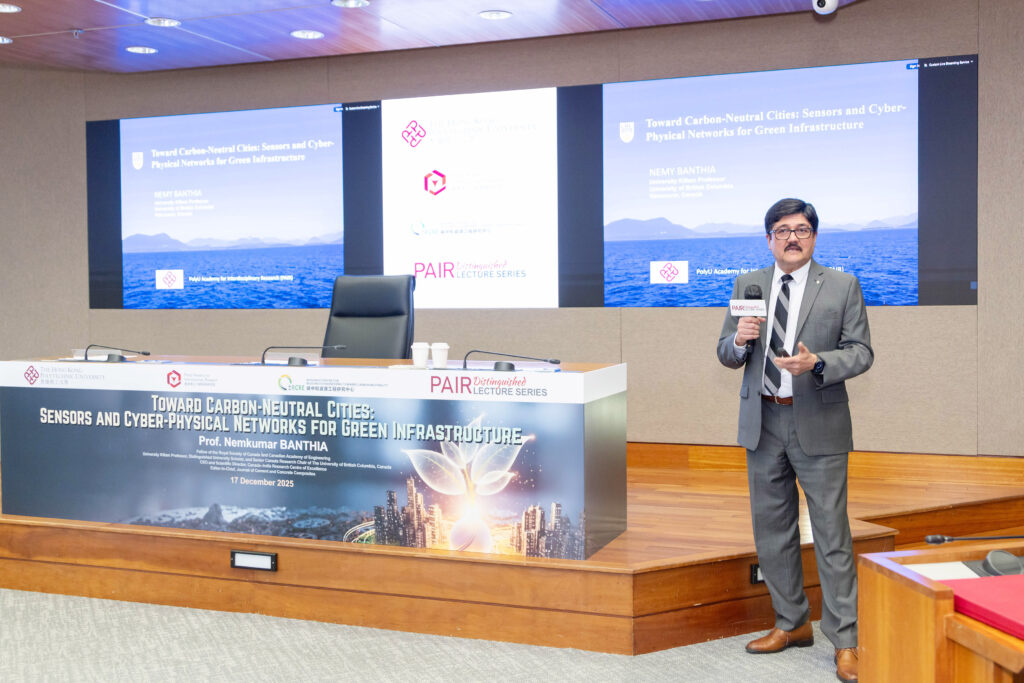
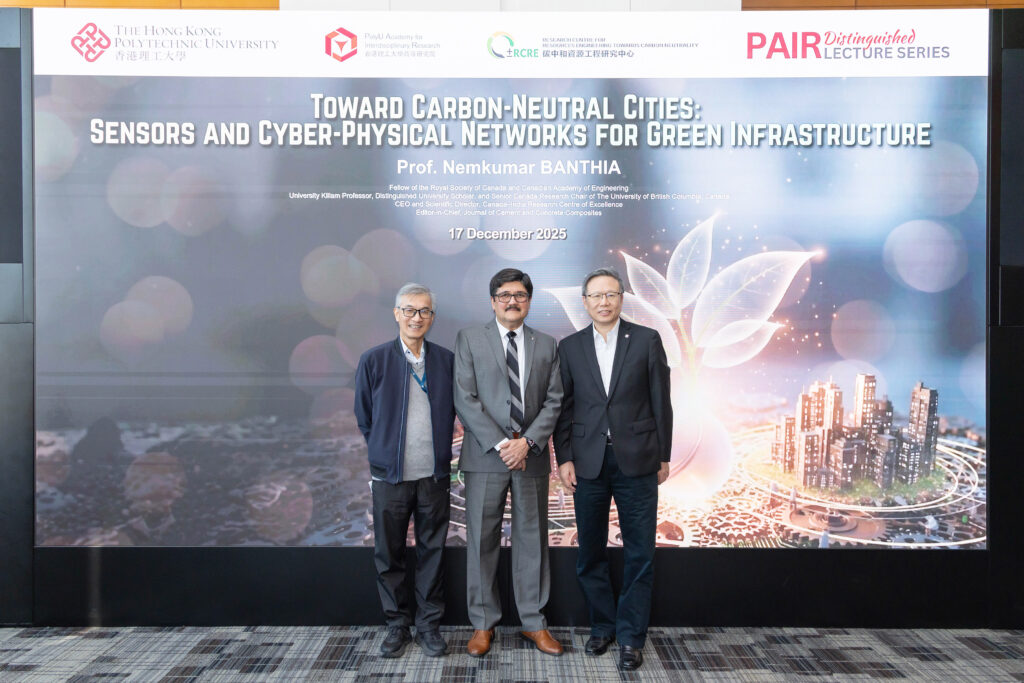
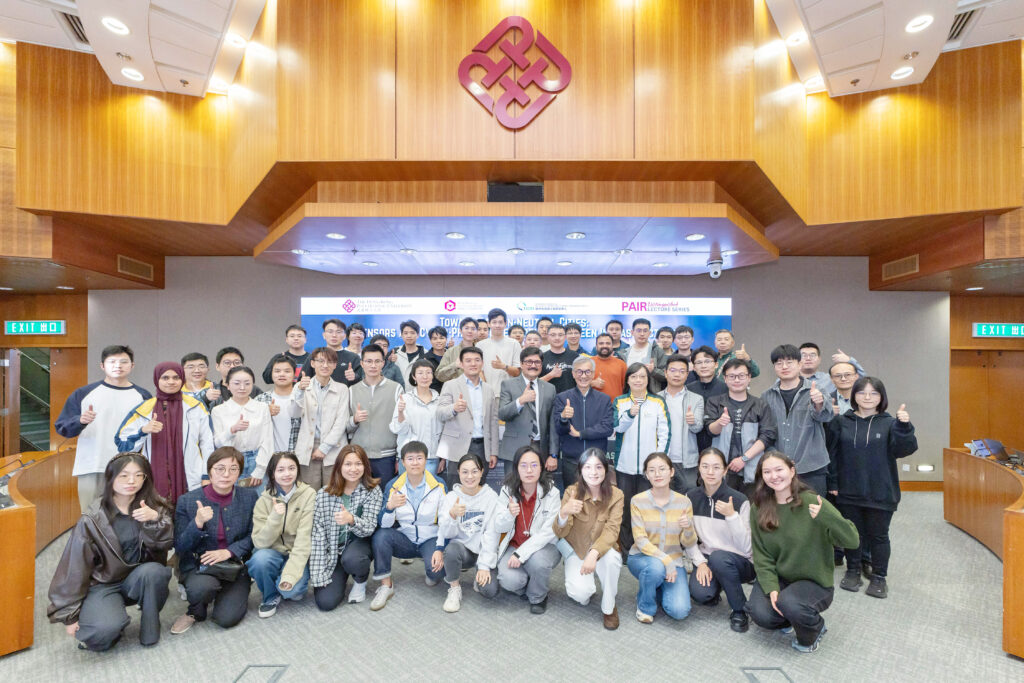
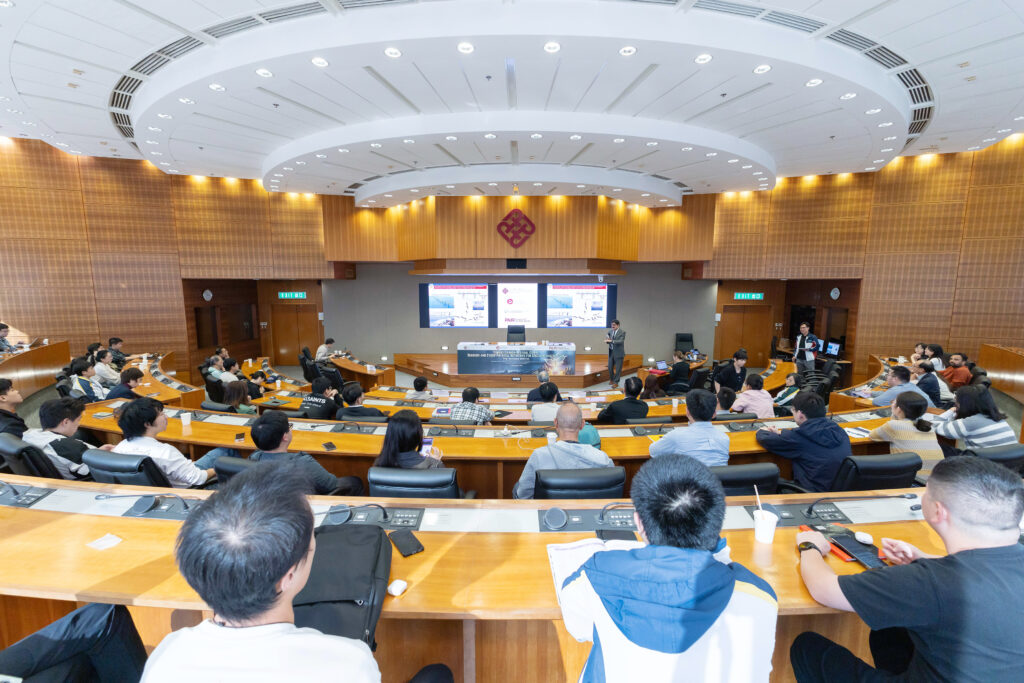
Professor Nemkumar Banthia delivered the PAIR Distinguished Lecture in Hong Kong on December 18, drawing a standing-room-only audience of more than 18,000 people from 31 countries. The lecture, Toward Carbon-Neutral Cities: Sensors and Cyber-Physical Networks for Green Infrastructure, explored how the materials and systems that shape our cities can be redesigned to curb emissions, while becoming more resilient to a warming world.
A carbon footprint woven into every building
Banthia began with a stark reminder: every structure we erect carries a carbon burden, from the cement in its foundations to the energy that powers its daily operations. Infrastructure, though often overlooked, is a silent driver of climate change. Portland cement production alone accounts for nearly 8 percent of global greenhouse gas emissions. Yet climate change is not only a threat to the environment; it also erodes the longevity of the very structures we rely on. Warming temperatures intensify cycles of expansion, moisture, and weather extremes, accelerating deterioration and raising maintenance costs.
“It is a two-way thing,” Banthia said. “We are emitting significant greenhouse gases from the construction sector, and climate change—our rising greenhouse gases—is also affecting our structures, making them less durable. It is a double whammy.” The consequence is practical: shorter lifespans demand more frequent replacements and repairs, driving up both carbon emissions and financial strain. “A bridge designed to last 50 years may now last only 30 because of climate change,” he noted, underscoring the need to rethink urban design in the face of evolving conditions.
A holistic pathway to resilient, carbon-conscious cities
As climate challenges intensify, resilience becomes essential rather than optional. Banthia argued for a holistic approach that blends advanced infrastructure design with ongoing monitoring and rigorous climate assessment. The pillars of this approach are:
- Low-carbon materials and durable designs: Innovations in cement formulations and high-performance concretes aim to reduce embodied carbon while extending service life.
- Sensor-driven monitoring: Embedding sensors and employing non-destructive testing delivers real-time insights into structural health, enabling proactive maintenance and early problem detection.
- Predictive climate modeling: Site-specific projections help anticipate how environmental conditions will evolve, informing design standards, maintenance strategies, and risk mitigation.
- Together, these elements form a design–monitor–predict loop that empowers cities not only to endure disruptions but to anticipate risks, adapt swiftly, and prosper amid uncertainty.
- Design, monitor, predict: three pillars of resilience
- Banthia emphasized the triad as essential for climate-adaptive cities:
Design: Develop robust structures and codes that withstand earthquakes, floods, and other hazards, balancing resilience with material efficiency and embodied carbon.
Monitoring: Use ongoing or periodic assessments to understand performance over time, revealing hidden weaknesses and guiding timely interventions.
Prediction: Embrace uncertainty by assessing how environmental conditions have shifted since construction, including ground motions, flooding, scour, and corrosive environments.
IC-IMPACTS: a cross-border model for impact-driven innovation
A highlight of Banthia’s talk was IC-IMPACTS (the India-Canada Research Centre of Excellence), hosted by UBC. With roughly US$100 million in joint funding, IC-IMPACTS unites universities, industry, and communities to co-create deployable solutions to real-world challenges. Its track record speaks to the model’s vitality:
- 101 joint Canada-India projects have trained 1,327 postgraduate students.
- The centre has secured 34 patents and created eight startups, illustrating a robust pipeline from research to market.
A career dedicated to sustainable infrastructure
Banthia’s four-decade career has fused theory with practice. He has championed ultra-high-performance and self-healing concretes, carbon-neutral building materials, and sensor-based structural health monitoring systems. These innovations bolster urban resilience by enabling early detection of deterioration, extending service life, and supporting adaptive city systems that can respond to future climate challenges.
The message is clear: urban resilience requires deliberate design choices, continuous monitoring, and intelligent prediction—an integrated strategy for climate-ready cities. Cross-border collaboration, as exemplified by IC-IMPACTS, accelerates the path from laboratory breakthroughs to real-world impact, ensuring that research translates into sustainable, scalable solutions for cities around the world.